
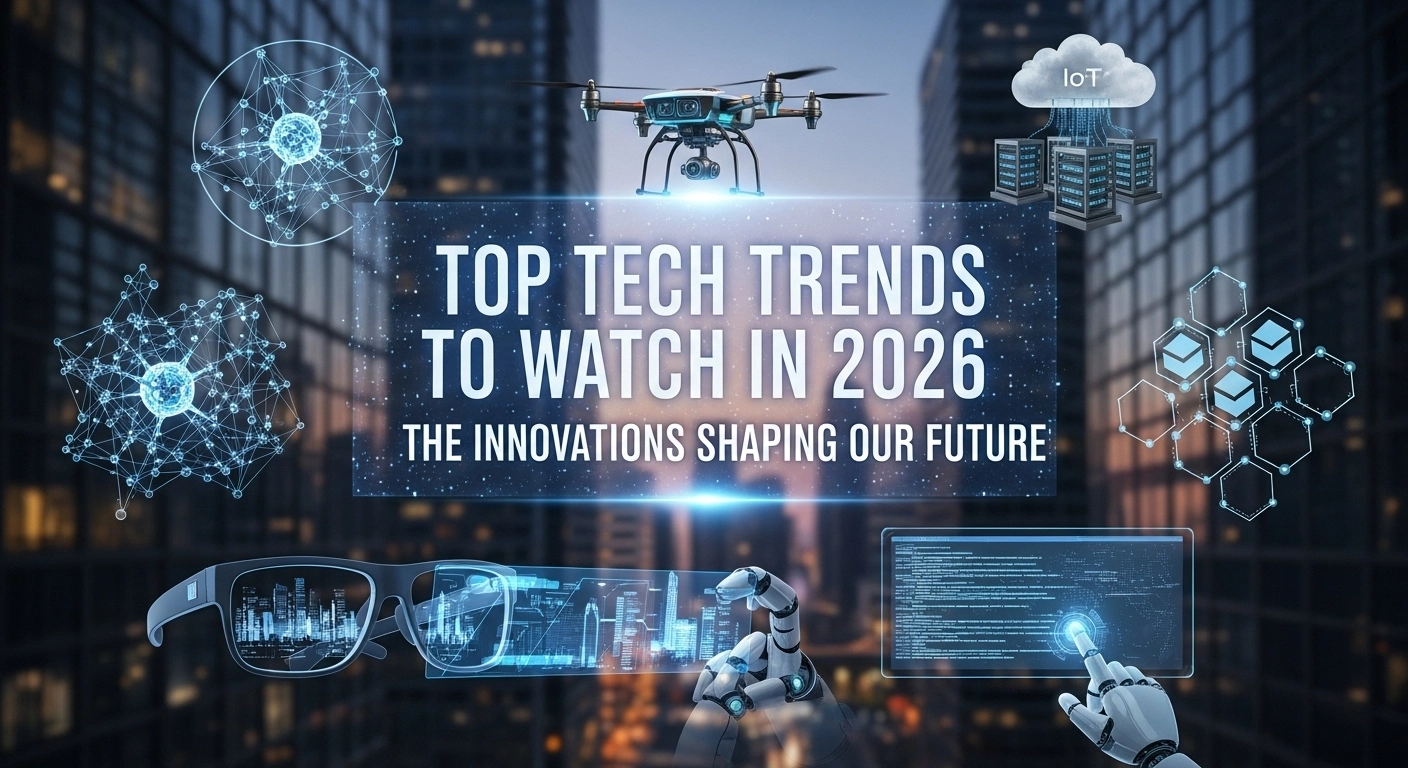
Every year brings a new batch of tech predictions, and most of them age badly within months. 2026, however, has a slightly different feel. Several trends that have been bubbling for a while, from powerful AI to electric vehicles to quantum computing, have reached a point where they are genuinely reshaping everyday life rather than living only in conference keynotes. This is one of those moments when the future feels noticeably closer than it did a year ago.
Thank you for reading this post, don't forget to subscribe!This post rounds up the tech trends worth paying attention to in 2026, not as a science fiction list but as a practical guide. Each one has real consequences for how we work, shop, travel and look after our health. You do not need to be a techie to care about any of them.
1. AI Everywhere, Not Just in Chatbots
The big story of 2025 and 2026 has been the quiet spread of AI into ordinary software. Your spreadsheet now suggests formulas. Your inbox summarises threads. Your photos app builds short films from the weekend without being asked. The user-facing chatbot has become just one face of a much wider change.
For most people, the benefits are practical rather than dramatic. Less time on admin. Faster drafts. Better search. The downside is the quiet shifting of jobs, especially in entry-level writing, customer service and coding roles. How companies and governments handle this shift will define the second half of the decade.
2. Agentic AI: Software That Actually Does Things
Where 2023 and 2024 were about AI giving advice, 2026 is about AI taking action. Agentic AI refers to models that can browse websites, use apps, book tickets, fill forms, and complete multi-step tasks on your behalf. Early versions are already built into some web browsers and assistants.
If you have seen demos of an AI booking a holiday for you while you make a coffee, that is agentic AI. The practical rollout is cautious, as it should be. But the direction is clear. A lot of the dull, repetitive computer work many of us do every day is about to become an assistant’s job.
3. The Electric Vehicle Transition Hits a New Gear
EV sales are now a normal part of the car market, not a curiosity. UK charging infrastructure has expanded substantially, battery ranges have improved, and prices for used EVs have fallen. For many families, an EV is now a realistic first or second car rather than a luxury.
The next few years will bring more competition from Chinese manufacturers, cheaper and longer-lasting batteries, and a mainstream shift toward electric vans and small commercial vehicles. Expect driving to become quieter, cheaper per mile, and steadily less associated with fossil fuels.
4. Smarter, More Capable Robotics
Humanoid robots have had a bumpy public image, but quietly, industrial and service robotics have matured hugely. Warehouse automation, surgical assistance, restaurant back-of-house, and even household cleaning are all seeing practical deployments. The same AI advances that power chatbots also allow robots to handle uncertainty much better than they used to.
For consumers, the most visible change so far is smarter robot vacuums and lawn mowers. For businesses, especially in logistics and healthcare, robotics is increasingly central to day-to-day operations. Expect this trend to accelerate through 2026 and beyond.
5. Quantum Computing Leaves the Lab
Quantum computing is not taking over your laptop any time soon, but 2026 is the year it moved from purely theoretical into targeted commercial use. Companies in pharmaceuticals, materials science, cryptography and logistics are now running real workloads on cloud quantum services.
The most practical impact for the public will come through encryption. Governments and security teams are already working on post-quantum cryptography to keep sensitive data safe when more powerful quantum machines arrive. This is the kind of background trend that matters enormously even if you never touch a quantum computer yourself.
6. Wearables Become Real Health Tools
Smartwatches and rings now do more than count steps. Models from Apple, Samsung, Garmin and Oura can flag atrial fibrillation, sleep apnoea, low oxygen and signs of infection. In 2026 more of this data flows directly into clinical care, with some NHS trusts piloting wearable integration.
For users, the practical upside is earlier warnings and better insight into how sleep, stress and exercise affect long-term health. The downside remains privacy, since health data is uniquely sensitive. Expect clearer regulation as the technology becomes mainstream medical kit.
7. Mixed Reality Finds Its First Real Uses
Augmented and mixed reality headsets have been years in the hype cycle, but practical uses are finally emerging in training, industrial design, remote assistance and surgery. The cost is still high, and everyday consumer adoption is modest, but the device category has found a foothold.
For most readers, the more interesting question is how smart glasses develop. Lighter frames with cameras, microphones and discreet displays are the form factor people are more likely to wear daily. Expect the first genuinely useful consumer glasses to arrive before 2028.
8. Clean Energy and Battery Storage
Solar, wind and grid-scale batteries continue to scale faster than forecasts. Home battery storage is becoming affordable enough that combining solar with a battery is a realistic option for middle-income UK households, especially with rising electricity prices.
This is arguably the most consequential trend on this list, even if it gets less attention than AI. A cheap, clean grid changes everything downstream, from EV charging costs to data centre economics to household bills.
9. Cybersecurity Becomes a Household Topic
With so much of life online, cybercrime has become a mainstream issue. Scams, ransomware and data breaches affect ordinary people every week. In 2026, cybersecurity is no longer just a corporate topic. It is something families, schools and small businesses think about regularly.
Expect more password managers, more two-factor authentication, more passkeys replacing passwords entirely, and more public awareness campaigns. The trend is toward simpler, stronger security built into devices by default, which is good news for most users.
10. Sustainable Tech and the Right to Repair
A quieter trend but an important one. New rules in the UK and EU are pushing manufacturers to make devices easier to repair, with spare parts available for longer. Combined with rising awareness of e-waste, this is shifting consumer attitudes toward keeping phones and laptops for longer.
Expect smaller, more repair-friendly phones, longer software support windows and genuine third-party repair services alongside the big-brand ones. The idea that a £900 phone should last two years is finally being challenged.
Final Thoughts
Tech in 2026 is less about single flashy breakthroughs and more about several long-running trends hitting their stride at the same time. Smarter AI, cleaner energy, better health tools and tougher security are quietly reshaping everyday life, usually in helpful ways. Keep an eye on them, adopt what genuinely improves your routine, and stay sceptical of anything overhyped. The next few years will be full of change, but the good news is you do not have to be an expert to benefit from any of it.