
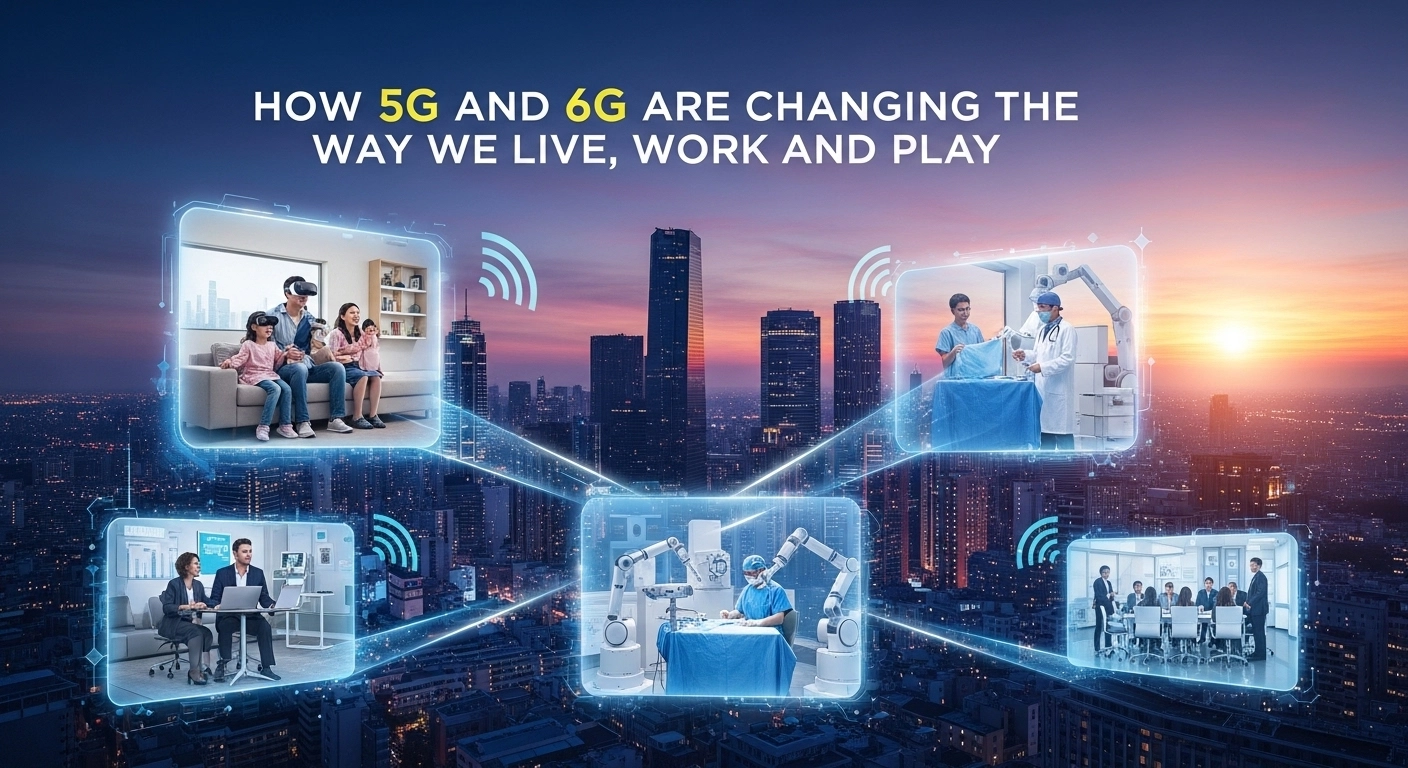
A few years ago, 5G was the great buzzword of every tech keynote. Today, it is part of everyday life for most of us. Faster downloads on the train, clearer video calls, smoother streaming. The real story, however, is quieter and more interesting. 5G is reshaping whole industries behind the scenes, and a first wave of 6G research is starting to bring its successor into view. This post explains what has actually changed, what is coming next, and why it matters to the rest of us.
Thank you for reading this post, don't forget to subscribe!What 5G Actually Changed
5G was never only about faster phones. Its real advantage is much lower latency, the delay between sending a signal and getting a response, along with the ability to handle far more devices at once. That combination unlocks a series of uses that 4G could not support well.
Think of busy stadiums where everyone’s phone works at once. Think of smart factories where hundreds of machines coordinate in real time. Think of remote medicine where doctors can guide a specialist halfway across the country with almost no lag. All of these rely on 5G’s mix of speed, capacity and responsiveness.
5G in Everyday Homes and Commutes
For most consumers, the most obvious benefit has been fixed wireless broadband. UK households in hard-to-reach areas have been using 5G home routers to get fibre-like speeds without the wait for a fibre line. Operators like EE, Three and Vodafone now offer 5G home broadband plans that often beat fixed-line options on price.
On the move, hotspotting with a 5G phone has become reliable enough that many travellers skip hotel Wi-Fi entirely. Game streaming services like GeForce Now and Xbox Cloud Gaming are playable on trains, which would have seemed silly not long ago.
5G for Businesses and Factories
The more significant revolution is happening in industry. Private 5G networks inside large factories let machines communicate instantly and securely, with far better performance than Wi-Fi in noisy environments. Ports, mines, hospitals and warehouses across the UK are installing these private networks to enable automation, robotics and live data dashboards.
This matters outside the factory gate too. Manufacturing efficiency translates to shorter lead times, cheaper goods and more resilient supply chains. The benefits eventually reach every one of us through what we buy and how quickly it arrives.
5G and Connected Vehicles
Cars have become computers on wheels, and 5G is what keeps many of them connected. Emergency call systems, over-the-air software updates, real-time mapping and traffic prediction all rely on fast mobile data. Some vehicle-to-infrastructure projects even use 5G to let cars talk to traffic lights and speed cameras directly.
Full self-driving remains rarer than headlines suggest, but the building blocks are settling into place. Lower latency and higher capacity mean a car can make and receive information in milliseconds, which is exactly what self-driving needs to work safely.
What 6G Will Add
6G is still early. Standards are being finalised, and the first commercial deployments are unlikely before 2030. But research is already well underway, and the shape of 6G is becoming clearer.
Expect speeds measured in hundreds of gigabits per second, near-zero latency, and integration with satellite networks so connectivity reaches anywhere on Earth. 6G is also being designed with AI built into the network itself, allowing far smarter management of traffic, devices and energy use.
Holograms and Immersive Experiences
One of the most talked-about 6G applications is real-time holographic communication. Imagine a 3D, life-sized video call that feels like the other person is in the room. Early prototypes exist today in research labs. With 6G bandwidth and latency, it becomes practical at scale.
The same underlying capacity will drive richer mixed reality, smarter wearables and more photorealistic gaming. Whether we end up all wearing smart glasses is another question. But the networks that would support such a world are being planned now.
Smarter Cities, Greener Grids
6G is being designed with energy efficiency and sustainability as first-class features, not afterthoughts. Smart cities will depend on networks that can manage millions of sensors, streetlights, bins, air-quality monitors and public transport nodes, all on low power. Smarter grids will balance electricity supply and demand at the second-by-second level.
That matters for the transition to renewables. The grid of the future is far more distributed than today’s, with solar panels, batteries and EV chargers everywhere. Coordinating it well is impossible without robust, low-latency connectivity.
Privacy, Security and the Flip Side
More connectivity means more data. Every device talking to every other device produces an ocean of information that needs to be secured. 5G and 6G networks are being built with stronger encryption and segmentation by default, but risks remain.
Expect continued debate over which companies and countries should build critical network infrastructure, given how strategic it has become. Users can play a part too by sticking to trusted devices, keeping software updated and paying attention to the privacy practices of the apps and platforms they use daily.
What It Means for You Right Now
In the short term, 5G will continue to roll out across the UK, with more rural coverage and improved indoor signal. Home broadband over 5G will become a mainstream option, particularly for renters or people in flats where fibre is awkward. Business users will see faster video calls, more reliable travel connectivity and the quiet spread of automated services.
6G is further off, but it is worth being aware of. The services you use most, video calls, shopping, gaming and health, will be designed with the assumption of near-instant connectivity, which will raise the bar for how fluid and responsive digital life feels.
Final Thoughts
5G is no longer the future. It is the present, and it is quietly changing how we work and live every day. 6G is the next chapter, still being written in research labs and standards committees, but already shaping what designers of cars, factories and phones plan for. Networks may be invisible, but their impact is everywhere. The more seamless they become, the more possibilities they open up for everyone, not just tech insiders.